
Don’t give a damn about happiness
Applied Neuroscience Strategist, K-Selected Biohacker, Tantric husband, Promethean peaceful parent, Adventuring philosopher, Raconteur, and Author. He spent +14 years researching the intersection of human performance enhancement and advanced personal growth in his obsessive quest - spanning three continents - to find real-life "NZT-48."
Happiness is the enemy of the future. Happiness is like a mirage in the desert; it eludes your grasp when you most strive for it. And yet, in my first book, I wrote about how…
“I’ve found the happiness that I didn’t give a damn about…”
Here I’ll explain why not giving a damn about happiness makes you happier, quantitatively and qualitatively...
Hedonic adaptation
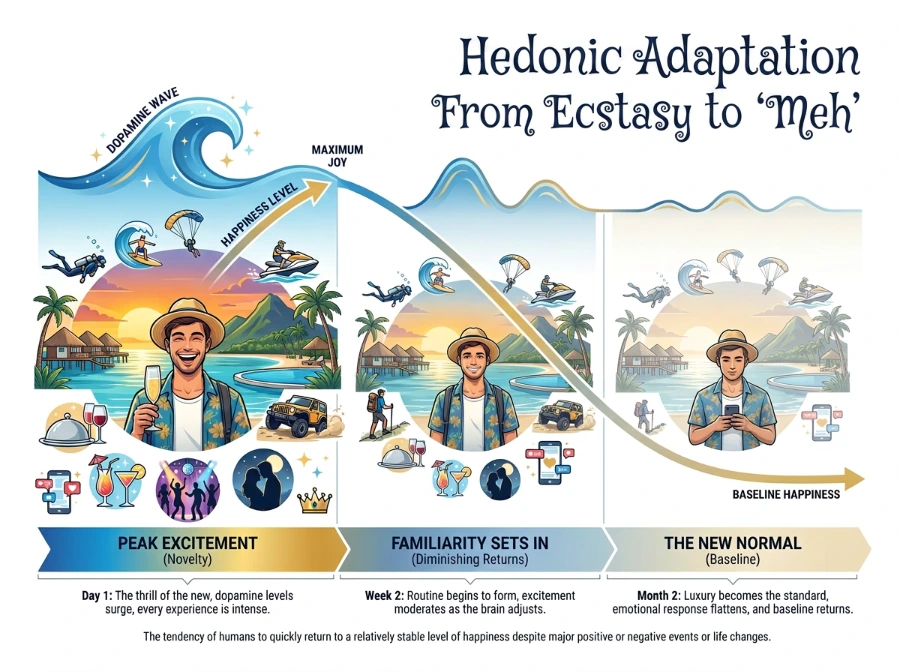
To illustrate the principle of “hedonic adaptation,” I’d like you to think about going on a vacation; imagine the most awesome vacation...
You fly to some beautiful exotic place with resplendent weather.
You check into an opulent hotel and settle into a well-appointed room with breathtaking views.
Maybe you’re vacationing with your best friends, or your family, or your significant other, or you’re alone (might be the way you like it).
No expense is spared doing the most awesome stuff; you take Scuba lessons, go surfing, go skydiving, jetskiing, hike serene mountain trails, do winter sports, rent off-roading vehicles, etc.
You meet the coolest, sexiest people poolside at your swanky hotel.
Your cool new friends invite you to join them for dinner and drinks at the top-rated-on-Tripadvisor local restaurants and bars. You gorge yourself on delicious (fresh sea) food while sipping top-shelf booze and laughing and swapping stories with your new friends.
Then you all go out to the most awesome parties or clubs; the music is bangin’, the people are sexy, and the drinks are strong (maybe you even do party drugs) — the revelry persists until the morning sun peaks over the blue horizon of the sea as you stumble back to your hotel room with a smile on your face.
You’re having a lot of sex (sometimes twice a day) either with your significant other or with some sexy (and tan) person you’ve met. It’s exciting and sometimes adventuresome sex.
And, of course, the whole time you’re uploading videos and photos of your awesome vacation on social media; the likes, emoticons, and (sometimes jealous) comments flood in with every upload.
It’s EPIC!
But, as you know, if you’ve ever had an epic vacation, it gets OLD, FAST!
Even with days filled to the brim with novelty, debauchery, and adventure, after a week or two, you’ll be pretty sick of vacation. Welcome to hedonic adaptation; you’ve been racing on a hedonic treadmill that’s become a hamster wheel going nowhere. You could stave off your hedonic adaptation to your glamorous life of fun in the sun by about a week by abstaining from drugs and booze, but eventually doing all these very fun things will just become tiresome. You’ll start to yearn for your normal life back home. Odd isn’t it?

I can attest to “hedonic vacation fatigue” myself! I’m writing this on the final day of a decadent week that my wife and I have spent at the black sea. We lounged at the beach and swam every day, read books, ate great food, I did meditation at sunrise, we had amazing coffee (spiked with Bailey’s liqueur), and we banged (righteously! On the beach even, beneath the stars one night — which was very exciting — and also righteous.)
I realize that thanks to the great pandemic/plandemic of 2020, a lot of people didn’t get to take a vacation this very weird year. We were able to because…
- We lived pretty spartanly this year; we stopped dining out. I spent my money on “doomsday” food prepping (which doesn’t seem so paranoid now, does it?)
- And we dressed up for each other and did our date nights at home.
- And the black sea coast is an AMAZING vacation value, especially at the end of September.
Before I got married, I took a grand total of two real vacations totaling two weeks in about 15 years. Since I’ve been married, I’ve adopted the Southern European lifestyle (a bit) and spend a few weeks a year on holiday (as the Brits say).
And, after a week, I’m glad to be getting back to my not-terribly-exciting life back in Sofia. Hedonic adaptation intervenes not just on vacation as you get sunburnt, but with almost everything; what makes you happy will soon make you bored.
- We’ve all had friends that started dating some sexy, exciting, cool new person, which for the first few months made them very happy. But, eventually, they grew bored with them. The red pill dating gurus like to say, “For every beautiful woman that you see or meet, just remember, there is a guy(s) out there that has grown sick and tired of having sex with her…”
- Booze, drugs, and sex will make you very happy for, at a maximum, a few hours, and then you’re not so happy when you come down from the high, and you have to deal with the consequences of your indulgences.
- Eating decadent food will make you feel great for at most a few hours, but then it does nothing for you.
- You buy a fancy new electronic toy or gadget. It makes you very happy for, at maximum, a few weeks, and then it’s just another thing in your life.
- You drop hundreds of dollars on the hot new smartphone, and you beam with pride every time you take it out of your pocket. But after not long, it gets scratched, and people no longer ask, “Is that the new smartphone?”
- You move into a nice new place or get a new car, and you’ll be very happy living there or driving it for a few months, but after a year it’s not so special.
The fleeting nature of happiness is my reason for not giving a damn about happiness.
You might say…
You’re describing a bunch of cheap thrills, of course, they don’t make you happy permanently.
Yeah, that’s something that we all hopefully learned at a young age. But my objection is to making happiness your compass in life. Instead, make meaning your compass, and trust me, you’ll be a lot happier in the long term.

I’m an ethical hedonist, which means choosing the greater pleasure over the lesser pleasure. It entails passing up on a lot of frequent pleasures. This is why we do our date nights at home instead of going to swanky restaurants weekly. This is why we do a 24-hour fast every week (THIS is why, as you can see, my sexy wife and I are fit and skinny; we didn’t gain any weight during the COVID-19 lockdowns while a lot of people were getting chubby).

Recently, a video went very viral of Jada Pinkett and Will Smith discussing Jada having an affair with some dumb rapper. In the video, Jada is conspicuously unapologetic, and at one point she says something very telling…
I just wanted to feel good, it had been so long since I felt good…
Normal people will shake their heads in disbelief that someone privileged with incredible wealth and luxury just didn’t feel good. We also can’t say that Jada and Will don’t pursue meaning; they’ve been hugely successful and have formed a beautiful family. I’ll remind you that Jada has been into a bunch of wu-wu “draw happiness from within” stuff for decades; according to interviews, she meditates daily in a meditation lounge (in their $42 million mansion!) I’m sure that their situation was complicated and we know that these kinds of scandals are often manufactured for perverse reasons. But happiness is clearly her compass, and we can see in this example and innumerable others how making happiness one’s compass poisons meaning and has negative consequences. If Jada can’t afford enough happiness to "feel good," that should tell you something about happiness!
Every couple of years we see a case of some high-profile celebrity committing suicide inexplicably. These people with fame, money, and unlimited access to luxuries that we can only dream about just can’t take life anymore and decide to end it. Excess happiness and indulging in cheap thrills seem to rob even a meaningful life of the will to go on.
What’s the solution?

Buy a compass and leave it somewhere that you’ll see it often, as a reminder to make meaning your compass.
Happiness is a genetic mechanism that our selfish genes have crafted for their own perpetuation. It drives us to reproduce and then to eat a lot of food that will result in our demise so we can get out of the way of the coming generations (this is the Phenoptosis hypothesis, and it can be Biohacked). Almost every parent agrees that nothing makes them happier than their children. So becoming a parent (responsibly) is the surest bet for attaining lasting happiness. These people who stylishly shirk parenthood are just about guaranteeing themselves an unfulfilling and (ultimately lonely) life of chasing the mirage of fleeting pleasures. Current year update: I'm now a parent, and that's the truth. Life has never been happier or more hectic...
The spirituality-happiness connection
I recently published a thriller novel in which I encode my nearly 15 years of personal growth self-experimentation...

In it, the events of one chapter transpire at a wu-wu personal growth retreat, and I have a scene with a guru who explains the difference between real spirituality that makes you profoundly happy and superstition...
The guru surveyed the audience: “Raise your hand if you are a spiritual person.”
Every hand shot up, except Xavier’s. I’ve never heard a definition of spiritual that made any sense. I don’t go to church and don’t pray. So not spiritual, I guess…
“Now, keep your hands up only if you experience deep, profound happiness every single day.”
Most hands fell.
“I’ll challenge you, friends. Most of you are not, in fact, spiritual but superstitious.” He turned to Astrid and asked her, “Are you religious?”
“I’m spiritual, not religious.” She responded
Why did he single my girl out?
“Spiritual, not religious. That’s how many identify these days, and that’s fine, but I contend that most are confusing superstition for spirituality.”
An event staffer brought some logs and kindling, which he coaxed a flame from in the firepit behind Sage. The guru gestured widely…
“This place is called Purgatory; named for some reason, after this religious idea of the limbo where we are held between heaven and hell for some indeterminant amount of time after this life. In secular modernity, many would call this pure superstition because there’s no evidence for it. But even modern spiritual persons, like yourselves, have faith in that which lacks evidence. Raise your hands if you believe that there is some unseen dimension of this universe and that some force or being greater than yourself has a benevolent plan for your life, which is yours to realize.”
Again, every hand other than Xavier’s shot up.
“That’s what I believe also, friends. But, frankly, we could be wrong. It could all just be random. Our spiritual view is a choice to believe in the unseen at work instead of the evident randomness of the universe. If faith in the unseen is merely the more comforting choice, then really, we’re superstitious. We’re like children who believe in Santa Claus. True spirituality is not just belief but action, practice, and habit. And you’ll know you’re doing it right if you experience deep, profound happiness every single day. I told you that you’d leave here with a better conception of happiness: lasting happiness is the reward for true spirituality, which is, in a word, gratitude.”
The guru paused to let that sink in. Astrid cuddled up closer to Xavier as a chill breeze caressed them.
“But when I say gratitude, I’m not referring to the feeling. I’m referring to the act, the practice, the habit that precedes the feeling - precedes, friends. 99% of people have got things backward when it comes to this: they think happiness and gratitude come after you get what you desire. But this is wrong; gratitude must come first. After gratitude comes happiness, satisfaction, peace, and clarity, then, in a position of receivership, what you desire shall come to you. Or not, it might not be the right thing for you. But you’ll be happy anyway.”
“But, how is that done practically…” Alejandra interjected
“Ah, well, that’s the easy part. Religions gather their followers in a place of worship on a regular basis weekly, where they give praise to their creator for whatever they have to be thankful for. But I contend that what religion gets wrong is that they call to gather only once, twice, or a few times a week to focus on gratitude. Really, it’s something we need to do daily. So it could be as simple as meditation or a breathwork session in the morning, where you spend 10-20 minutes focusing on what you have to be thankful for. There’s always something. This is what I call antifragile happiness; it sustains and gets stronger and more adaptive when life gets rough.”
Now, this guy is speaking my language.
“But once daily might not be enough; what about hourly? Could we meditate on gratitude for a few minutes hourly or at least once in the AM and once in the PM? I do. And here’s how I remember to do that: I don’t bring my smartphone to the bathroom with me. While I do my business in the bathroom, I meditate on whatever little thing I have to be grateful for. Sometimes, it’s simply that I can afford luxurious two-ply toilet paper instead of the cheap stuff!”
Epicurean living

The Greek philosopher Epicurus (who lived 2000 years ago, not that far from where we vacationed) nailed happiness when he prescribed what we term Epicurean living instead of indulging in cheap thrills for living a happy life. Epicurean living means being surrounded by your friends and people you like, prioritizing community. A true Epicurean would make his best friends his neighbors. In stark contrast to modern life, where many live in apartments just meters away from people that they don’t know or particularly like, and then spend their days working with people they don’t like. No wonder we’re so obsessed with finding happiness!
Finally, I suggest that you redefine happiness in your mind, because...
Absence of pain > pleasure
Chronic suffering hurts a lot more than happiness feels good, so happiness should be the absence and avoidance of chronic, long-term suffering.
For example, this year I read some good books about the horrifying specter of the cancer epidemic; the experts are telling us that we all have about a coin flip’s chance of getting cancer in our lifetimes. The suffering entailed in having cancer cannot be overstated; you should move heaven and earth to avoid it. I just finished an important book on this topic, The Plant Paradox by Dr. Steven R. Gundry; it’s about how many of the fruits and vegetables that you may think are healthy actually cause cancer and a host of other diseases. And I know what you’re thinking…
Oh great! Now fruits and vegetables cause cancer? What the heck am I supposed to eat then, water?
Well, it’s a bit more complicated than that, which is why you should at least check out my book review…

Meaning vs mirage
I'll leave you with a paraphrased section from my novel
So - and this one took me about a half-century to figure out - don’t pursue happiness, don’t give a damn about happiness, and don’t expect much happiness. Pursue meaning. True happiness comes from meaning, but it’s a quiet happiness. A happiness you only take note of when you slow down and listen to your soul.
If you need a little more inspiration to choose meaning, listen to this epic opera song about ethical hedonism...
Join the Limitless Mindset Newsletter to...
Get weekly edifying content about Biohacking, Lifehacking, and my holistic pragmatic antifragility philosophy. This informative (and often entertaining!) newsletter is about how to take advantage of the latest anti-aging and Biohacking science, and where I dispense timely mindset nuggets, lifehacking tips, and my own musings.Don't worry! This just signs you up for our informative weekly newsletter (actually worth reading), NOT an aggressive automated marketing machine.
Watch this recent video...
-
{{#owner}}
-
{{#url}}
{{#avatarSrc}}
{{name}} {{/url}} {{^url}} {{#avatar}} {{& avatar}} {{/avatar}} {{name}} {{/url}} - {{/owner}} {{#created}}
- {{created}} {{/created}}


 ON RUMBLE
 on twitter