
We Are As Gods
Applied Neuroscience Strategist, K-Selected Biohacker, Tantric husband, Promethean peaceful parent, Adventuring philosopher, Raconteur, and Author. He spent +14 years researching the intersection of human performance enhancement and advanced personal growth in his obsessive quest - spanning three continents - to find real-life "NZT-48."
Book Review: The Age of Abundance is for the Avaricious
In the current year, it certainly feels like we're all hurtling into a Dystopian cyberpunk future. Doesn't it?
Being chauffeured through a decaying urban center in a self-driving taxi is no longer an unsettling novelty. Your smartwatch vibrates as you doomscroll videos of soldiers fleeing drones across a forlorn battlefield, warning you that your heart rate variability is non-optimal. You take Nootropic cognitive enhancers for the edge you desperately need at work; hopefully the soulless megacorporation you work for won't replace you with AI agents. An ad pops up for the exact thing you mentioned to your girlfriend, in bed last night, while you thought your phone was off.
It's not just you; it's getting weirder out there—we're just a few holidays away from your socially awkward cousin bringing a robot girlfriend home. (Yes, I just em-dashed—UNAPOLOGETICALLY—I em-dashed before AI did and will continue to dose my hyphens with Viagra whenever I damn well please).
For decades, science fiction has issued us a warning: Don't succumb completely to the siren song of technology. A warning we've collectively failed to heed. That siren song serenades us with the promise of abundance. Abundant energy, food, information, and health. Abundance that might just be... for all of us.
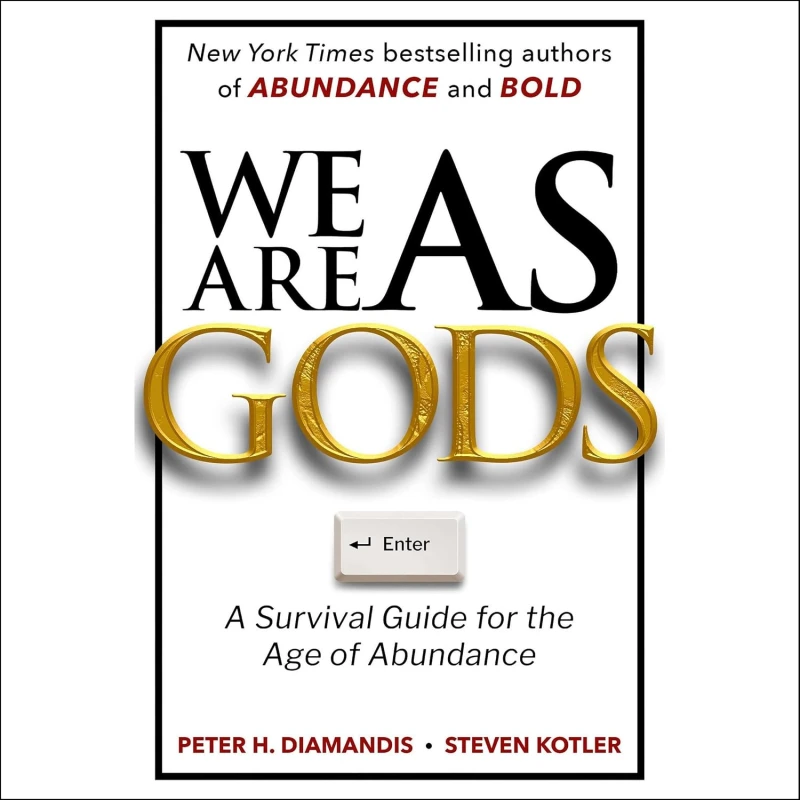
Like you, I don't quite doomscroll, but often find myself mesmerized by and bemoaning the techno-absurdistan of modernity. It seems like everything, everywhere is getting worse--technology is making life for us humans too weird, too fast. But maybe the popular pessimism about progress (pervasive in nearly any media we consume and then confirmed by our anecdotal experiences) is dead wrong. As a pragmatic realist who leans optimistic when I can, I wanted a dose of optimism about the future, so I cracked open We Are As Gods, A Survival Guide for the Age of Abundance, by Peter H. Diamandis (whose face will probably appear if you do a Google: techno-optimist) and Steven Kotler, whose work on flowstate has been of keen interest to me as a Biohacker.
__author imgs
I got the dose of optimism I wanted from We Are As Gods, and I'll second-hand deal it to you here. But I got more: inspiration to endure and aspire because--spoiler alert--the age of abundance is not for all, but for the avaricious.
We Are As Gods
Yes, really, as gods—lowercase g because the book opens with a comparison of dozens of godlike powers from our mythology to what modern technology now enables. Omniscience (all-knowing), you've now got that in your pocket with Google and the AI assistant on your phone. Omnipresence: as I broadcast my words, image, and voice to you wirelessly via the internet, I'm, in a sense, present there with you. __
Resurrection of the dead--happens in hospitals all the time. And even immortality, an attribute long reserved for deities and demigods, is increasingly within the grasp of mere humans (take your NMN!)
AI: One Billion Times Smarter
__
We know the blistering pace of AI development demands that we consider a future with machines a billion times more intelligent than we are—which, it’s worth noting, is the rough equivalent of the difference between a human and a hamster.
Arthur C. Clarke on AI
In 1964, less than a decade after the Dartmouth AI conference, science fiction author Arthur C. Clarke foretold this future with uncanny accuracy: “[T]he most intelligent inhabitants of [the] future world won’t be men or monkeys, they will be machines, the remote descendants of today’s computers. Now the present-day electronic brains are complete morons, but this will not be true in another generation. They will start to think, and eventually they will completely outthink their makers.”
On the need for human evolution
For most of history, evolution has been the chief driver of change, and scarcity has been the chief driver of evolution. Fitness is the term biologists use. Fitness describes how well an organism is adapted to its niche and solves the challenges of scarcity. The fitter the fit, the better the chance of survival. A plot twist: Fitness doesn’t only describe how well humans fit into the external world. It also describes the pressures that shaped our internal world. Our mental machinery evolved to navigate scarcity: to spot opportunities, dodge threats, and prioritize survival—full stop. Yet, abundance flips the script. We’ve traded paucity for plenitude but haven’t upgraded our cognitive navigation system. So how do we traverse this new territory with our old maps?
Mo Gawdat on training AI
What Gawdat tells us, in his book Scary Smart, is that humanity’s best bet for survival is not to train our AIs. Rather, it’s to raise them. He argues that we should raise AI with the same kindness and love we raise a child. AI is not inherently dangerous, Gawdat maintains, but it learns from us. If we train AI with fear, bias, and hostility, it will replicate those qualities and—“Step away from the airlock, Dave.”
Gawdat’s point: AI’s superintelligence will emerge from its ability to process patterns beyond human comprehension, but its moral compass will be shaped by the behavior it observes in us.
On AI's EQ
AI agents proactively implement your goals, gather information, and get results. Think of them as digital assistants with a very high IQ and—thanks to Kaliouby—a growing EQ. This EQ is critical. The potential of AI agents lies in their ability to integrate into our lives. In the near future, they will be personal assistants, financial advisors, health coaches, and trusted companions. Imagine an AI agent that manages your schedule, automatically rebooking missed appointments, coordinating with other AI agents to plan those meetings at optimal times—then commiserating with you about the poor state of your work-life balance. The system will analyze activities and recommend adjustments, improving productivity and suggesting wellness interventions based on your health data (i.e., “Step away from the airlock, Dave, it’s time for your afternoon nap”).
AI for organ transplant
AI monitors tissue assembly at every stage. If a single layer of cells veers from its intended structure, the system notices and recalibrates in real time. This ensures higher success rates and far less waste—both critical in high-stakes manufacturing like organ production. The AI also optimizes scaffold density and tissue uniformity, which enables faster integration into the patient’s body post-transplant, which is a complicated way of saying far shorter healing times.
there’s an organ support system that provides a tenfold improvement in the useful lifetime of an organ, whether donated or manufactured; it makes no difference. Second, Rothblatt is working with the eVTOL (flying car) company BETA on an AI-piloted, autonomous vehicle-based organ delivery service—like Zipline, only for human body parts.
Creating organs at scale will demand an AI-supervised global network of specialized manufacturers, transportation hubs, and distribution systems. This infrastructure could produce thousands of jobs in biochemistry, robotics maintenance, and data management.
Sounds good, but those are all the kinds of jobs that AI will take.
“Free humanity from drudgery”
Is an idea that Diamandis and Kotler spill a lot of ink on, and it's worthy of your cogitation.
The proliferation of humanoid robots signals a shift from one-off creations to mass production. The market is set to explode. Advances in AI, actuator technology, and battery efficiency have reduced cost by over 50 percent since 2020. Both Figure AI and Tesla have humanoid robots projected to cost around $20,000 per unit. If this price point holds, the door for widespread adoption is wide open. In logistics, widespread adoption is already here. Nearly half a million autonomous warehouse robots operate globally. By 2030, the number is likely to exceed 1.5 million. Amazon reports that robots improve operational efficiency by 40 percent, with packages moving 30 percent faster through automated facilities.
Finally...
Join the Limitless Mindset Newsletter to...
Get weekly edifying content about Biohacking, Lifehacking, and my holistic pragmatic antifragility philosophy. This informative (and often entertaining!) newsletter is about how to take advantage of the latest anti-aging and Biohacking science, and where I dispense timely mindset nuggets, lifehacking tips, and my own musings.Don't worry! This just signs you up for our informative weekly newsletter (actually worth reading), NOT an aggressive automated marketing machine.
Photos
User reviews
-
{{#owner}}
-
{{#url}}
{{#avatarSrc}}
{{name}} {{/url}} {{^url}} {{#avatar}} {{& avatar}} {{/avatar}} {{name}} {{/url}} - {{/owner}} {{#created}}
- {{created}} {{/created}}
 ON RUMBLE
 on twitter